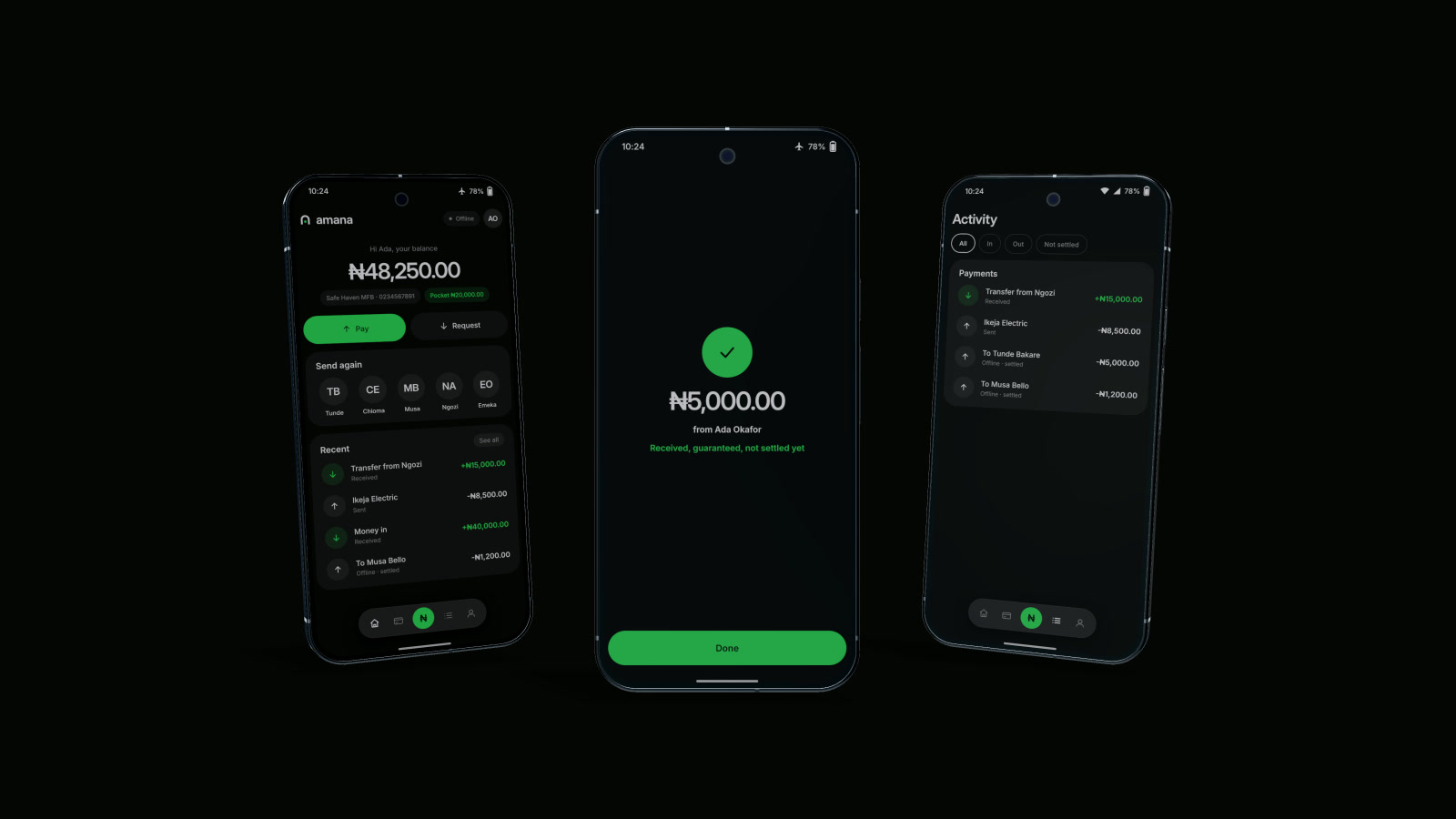
Hand it over. No network.
Show your code and they scan it. Neither phone needs the internet.
And it's checked on the spot. Their phone verifies the payment itself, so nobody has to trust a screenshot.
No data. No wahala.
Amana lets you send naira with no data, face to face or to any bank.
Cash never needed a network. You handed it over, and it was paid.
They're safer than carrying cash and faster than counting it. But they came with something cash never had: they depend on the network.
Amana
It pays like cash, with no internet. And it keeps your money as safe as a bank transfer.
Show your code and they scan it. Neither phone needs the internet.
And it's checked on the spot. Their phone verifies the payment itself, so nobody has to trust a screenshot.
Pay over Bluetooth with no signal at all. Nearby Amana phones can carry the payment on until one of them finds a connection.
No data, just phone signal. The money goes to their bank account, even if they've never heard of Amana.
Once either phone gets a connection, the payment settles. Nobody has to do anything.
Your naira stays at a bank. A licensed Nigerian bank holds every naira. Amana never holds your money.
Neither can an Amana payment. Each one is signed by a single-use key on your phone, and it's checked before the bank pays it. Try to spend it twice and it's refused.
While you're online, move what you'll need into your offline pocket.
QR, Bluetooth or SMS. No data needed.
Once either phone connects. You can also move your pocket back to your main balance anytime.
Only to sign up and fill your pocket. Paying works without it.
Send to their bank account by SMS.
Yes. The offline pocket has a cap, and we keep it small on purpose so offline payments stay safe.
No. You hold naira at a bank. Amana uses a public record only to check that no payment is used twice. It never holds your money.
Android first. iPhone is coming.
Trust. In Hausa (from the Arabic amānah), it means something held faithfully on someone else's behalf. That's what we do with your money.